

Golden Brother International Co., Ltd. convened its August 2026 Occupational Safety and Health (OSH) monthly meeting via province-wide video conference at 2:30 p.m. on Friday, August 28. During the meeting, Chairperson Dr. Lee specifically explained the “DuPont Ten Safety Beliefs” and provided examples of major occupational accidents derived from each safety principle. The purpose was to strengthen the promotion of OSH topics among colleagues in all regions, enable early risk identification and hazard assessment, and jointly eliminate potential risks.
The meeting proceeded in the usual order of Zhongli, Hsinchu, Changhua, Tainan, and Kaohsiung. Regional committee members first delivered concise reports on relevant issues in their respective areas. Chairperson Dr. Lee Wan-Chin then explained the “DuPont Ten Safety Beliefs” item by item to ensure full understanding among colleagues. The key points of the meeting are as follows:
1. Major Occupational Accident Reporting
The latest “Occupational Accident Investigation Report Form” previously announced by the Human Resources Department has not yet been issued. Colleagues are requested to note that, once released, the newest version of the investigation report form must be used for detailed reporting of occupational accidents.
2. Fire Drill Issues
Colleagues have not yet uploaded the fire drill information from each region to the intranet. Please take note of this matter: first, to archive and retain the records; second, to effectively respond to external audits. Colleagues are requested to review existing materials and upload them promptly. Thereafter, the company will be well-prepared for external audits by any client.
3. The “DuPont Ten Safety Beliefs”
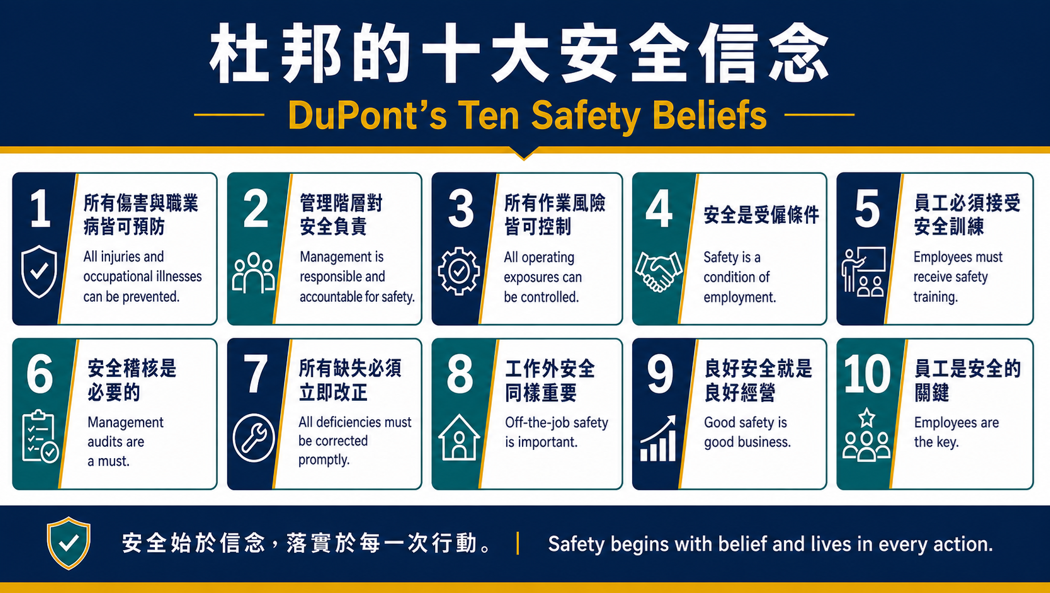
These ten key points are also published on the company website. For colleagues who have not yet fully grasped their essence, the main points of the Ten Beliefs are listed below. Detailed explanations and case illustrations can be found in the presentation on the company intranet.
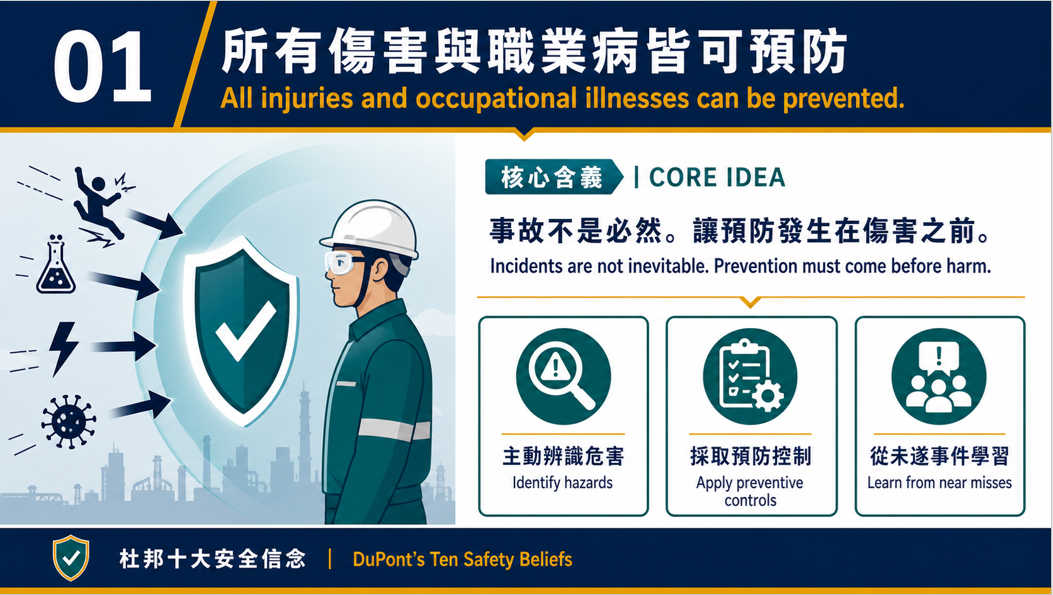
(1) All injuries and occupational diseases can be prevented
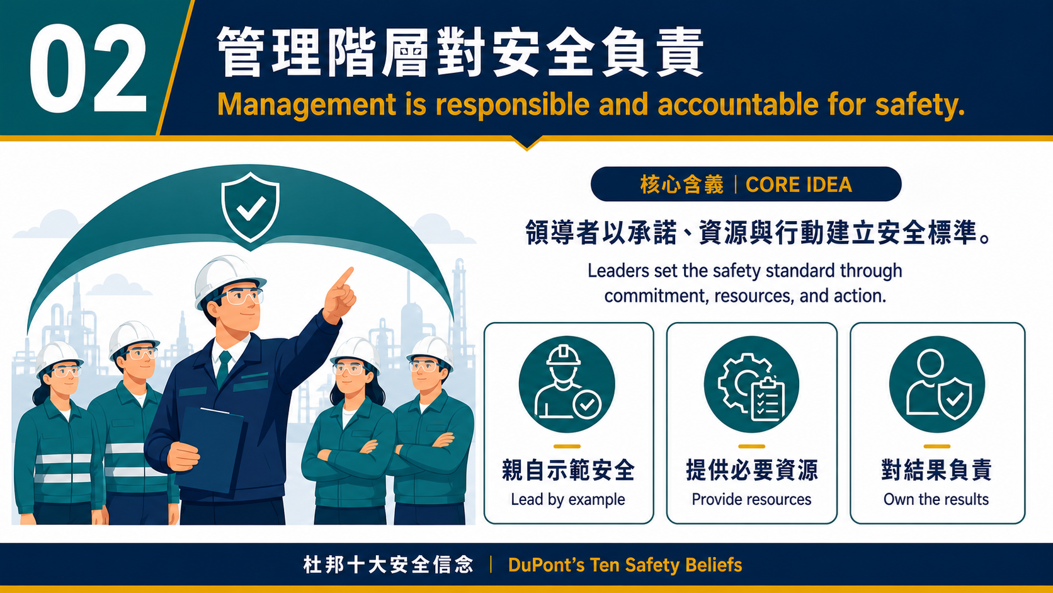
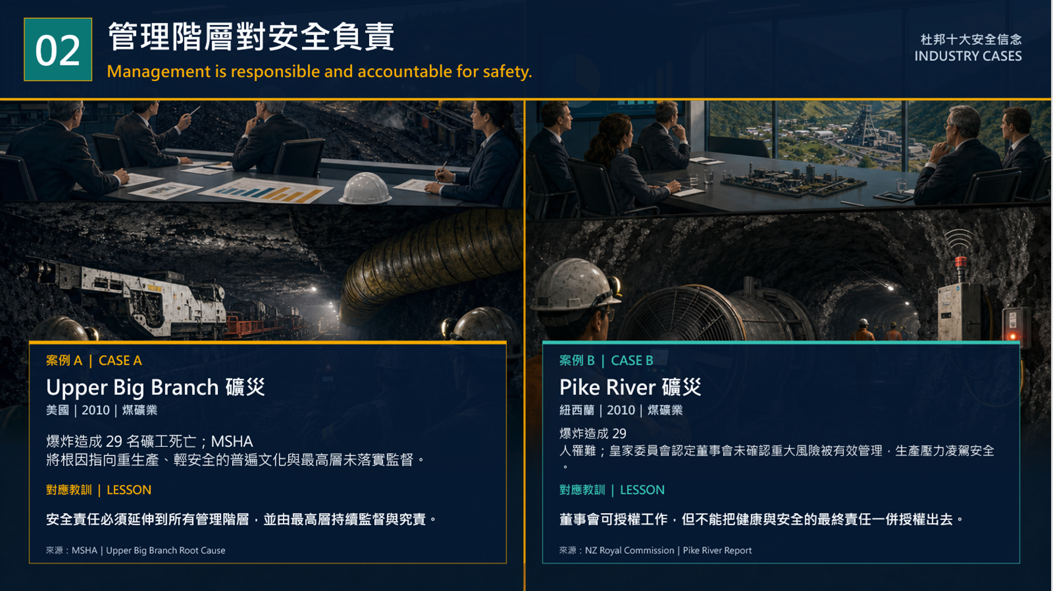
(2) Management is responsible for safety
(3) All operational risks can be controlled
(4) Safety is a condition of employment
(5) Employees must receive safety training
(6) Safety audits are necessary
(7) All deficiencies must be corrected immediately
(8) Off-the-job safety is equally important
(9) Good safety is good business
(10) Employees are the key to safety
Among these ten principles, employees are the people closest to the workplace. Therefore, every employee at the work site should actively inspect deficiencies for improvement in order to reduce risks. In addition, the company’s management bears an unavoidable responsibility; thus, managers at all levels must fulfill their duties and jointly uphold the company’s occupational safety and health matters.
4. Regulations for the Labeling and Hazard Communication of Hazardous Chemicals
The “Regulations for the Labeling and Hazard Communication of Hazardous Chemicals” were amended on August 26 and took effect immediately. Colleagues are requested to pay attention to Article 4 (items not applicable to these Regulations), Article 15-1 (deadline for correction of Safety Data Sheets), and Article 18-1 (items for which application to withhold hazardous chemical ingredients in the Safety Data Sheet content is not permitted).
It has been repeatedly reminded previously that “general consumer products for non-industrial use” are not subject to the “Regulations for the Labeling and Hazard Communication of Hazardous Chemicals.” Therefore, for such products—such as commercially available household toilet hydrochloric acid (toilet cleaner hydrochloric acid), bleach (household sodium hypochlorite solution), and correction fluid (liquid paper / Wite-Out)—there is no need to affix hazard warning labels. Please refer to the following website for details: https://www.golden-brother.com/index.php?action=news-detail&cid=10&id=5262&lang=EN
5. Request for Active Participation by Regional Supervisors
Over the past year, regional supervisors have been busy taking care of customers as well as the settlement and dormitory issues of newly arrived migrant workers, and thus have rarely attended the meetings. This serves as a reminder that the importance of OSH meetings is no less than that of any other meeting. As stated in the Ten Safety Beliefs: “Good safety is good business.” Supervisors are requested to fulfill their duties as committee members as much as possible in accordance with the statutory responsibilities of the OSH meeting.
After the meeting, Chairperson Dr. Lee once again emphasized that regional supervisors should pay greater attention to OSH issues. Once any potential risk materializes, it will pose a major challenge to the company’s operations and may even threaten the company’s survival. Therefore, colleagues are earnestly requested to carefully study the meaning of the DuPont Ten Safety Beliefs and internalize them as personal reflexive will.